


 Du Lun au Ven - De 9h à 18h
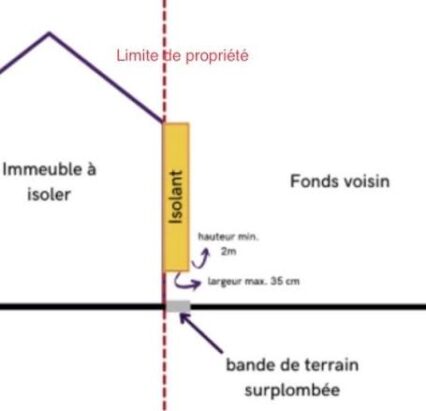
The Overhanging Easement (Servitude de Surplomb)
This easement, introduced by the Climate and Resilience Act, is designed to facilitate energy renovation works by allowing a property owner to overhang a neighbouring property.
It is frequently the case that wall insulation works must be carried out on the exterior of a building, in particular so as not to reduce the habitable floor area.
I. A Delimited Right
- Pursuant to Article L.113-5-1 of the Construction and Housing Code, this right is reserved to the owner of an existing building who undertakes external thermal insulation works. It may not be used for other works, such as facade rendering. The holder of the easement is entitled to exercise it only where no other means would enable them to insulate the property with equivalent efficacy and at a reasonable cost.
- The property owner may overhang the neighbouring land by a maximum width of 35 centimetres in order to install insulation material at a height of more than two metres from the base of the wall or from ground level, unless the owners of both properties agree on a lesser height.
II. The Procedure
- Before commencing works, the holder of the easement must notify their neighbour of their intention to exercise the easement over the neighbouring land. This notification must be accompanied by a description of the external insulation works, plans of the facades and, where applicable, the rooflines if they are affected by the works.
- The holder must also explain that no alternative solution would enable them to carry out the insulation works under equally satisfactory conditions (i.e. at a non-prohibitive cost for an equivalent level of energy efficiency).
- The holder must inform the neighbour of the amount of the compensation to be paid to them in advance in consideration of the temporary occupation of their property, and must notify them of their right to object.
- The agreement must be formalised in an authentic instrument drawn up by a notary, who will register it with the land registry (service de la publicité foncière).
The easement then confers upon its holder the right to access and encroach upon the neighbouring property by installing temporary structures, such as scaffolding, for the duration of the works — without requiring the neighbour’s consent.
The exercise of this easement is, however, subject to certain conditions.
USEFUL NOTE
The owner of the neighbouring land may object to the exercise of the easement within six months of the notification, on the basis of a serious and legitimate ground relating to the use of their property, non-compliance with the conditions governing the exercise of the overhang — such as an encroachment exceeding the permitted width — or where the purpose, character or enjoyment of their land would be permanently or excessively affected.