


 Du Lun au Ven - De 9h à 18h

1. Funeral services: what the funeral director must tell you
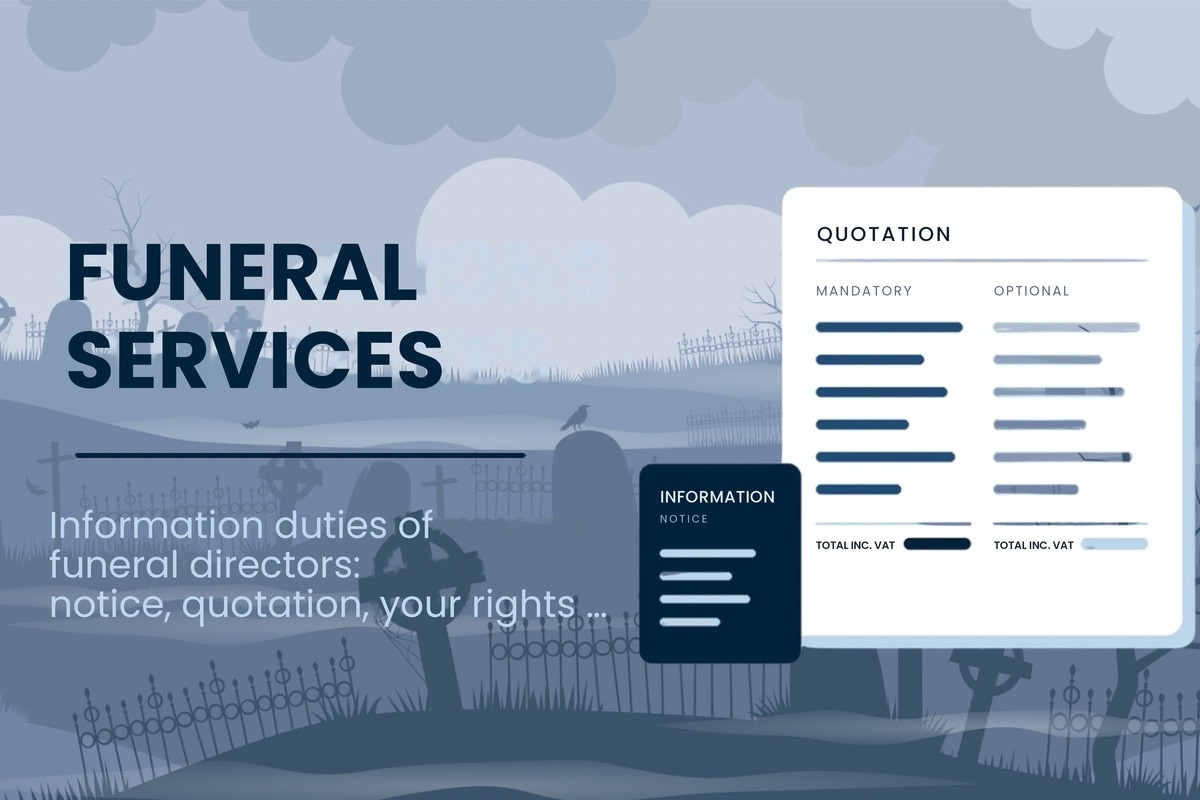
Since 1 October 2026, every funeral services provider must give families a standardised information notice, in addition to a free quotation drawn up on the official model.
1.1. The quotation: written, free of charge, on the official model
The quotation must follow the model set by ministerial order, in the version applicable since 1 July 2025.
The model separates two columns, each with its own total including VAT:
- mandatory services, for example the coffin with its watertight lining, four handles and name plate, the digging of the grave or the opening of the family vault, or the urn in the case of cremation;
- optional services, for example embalming, death announcements, floral arrangements, a master of ceremonies or the publication of a death notice.
Some services become mandatory only because of the circumstances: a body bag, a hermetically sealed coffin, or embalming, depending on the transport arrangements or the cause of death. The quotation must say so.
If you accept the quotation, you sign a purchase order. Any service added afterwards requires an amendment or a new quotation, signed by the person arranging the funeral. Since 1 October 2026, the provider must also give you an itemised statement of the services performed.
The provider may not add any mark-up to municipal fees or cemetery plot charges (Article L. 2223-34 of the French Local Authorities Code, CGCT).
You can compare funeral directors’ prices without travelling, using the model quotations filed with the town hall.
1.2. The information notice and the provider’s documentation
Since 1 October 2026, every provider must make available to you an information notice that is identical throughout France. It is neutral: no company name, no logo, no advertising. It is displayed so that it can be seen from outside the premises. It is also accessible from the home page of the provider’s website, if it has one.
It sets out:
- your rights, in particular the freedom to choose your funeral director, and the main formalities;
- the mandatory services, and those that become mandatory only in certain situations (health requirements, transport, preservation of the body);
- the fact that quotations are free of charge, and that you may approach several providers;
- the transport of the body, the places where the deceased may rest (at home, a hospital mortuary or a funeral home) and the scattering of ashes;
- the remedies available in the event of a dispute, including the consumer ombudsman to which the provider belongs.
The provider must also make its general documentation available to you, presenting its services and prices. This documentation must now be published on its website. It must clearly distinguish mandatory services, services that are mandatory depending on the circumstances, and optional services.
The list of licensed funeral services providers is displayed in hospital mortuaries, funeral homes and crematoriums. It is also available from the prefecture, the town hall and healthcare establishments.
2. Checking whether a funeral plan exists
Before signing a purchase order, check whether the deceased had taken out a funeral plan. The search is carried out through AGIRA, the French association that manages insurance risk information, online at agira-vie.fr/obseques
If a plan exists, it may already specify the funeral director, the services, or a sum set aside to pay for them.
The family must then respect the wishes of the deceased.
3. Paying the costs and the role of the notary
The person arranging the funeral may have the invoice paid from the deceased’s accounts, up to the available balance. They simply present the funeral invoice to the deceased’s bank (Article L. 312-1-4 of the French Monetary and Financial Code).
For the calculation of inheritance tax, funeral costs are deducted from the estate up to a flat-rate limit of €1,500 (Article 775 of the French General Tax Code).
PARGADE Notaires assists you in settling the estate. Keep the quotation, the purchase order and the invoice, as your notary will need them.
 PARGADE notaires will be closed on 11 November (French public holiday). Messages will be answered the next working day.
 Family cash gifts: taxed at a 6% rate, up to €100,000 per donor and per donee, under the 2027 Finance Bill (PLF 2027).