


 Du Lun au Ven - De 9h à 18h
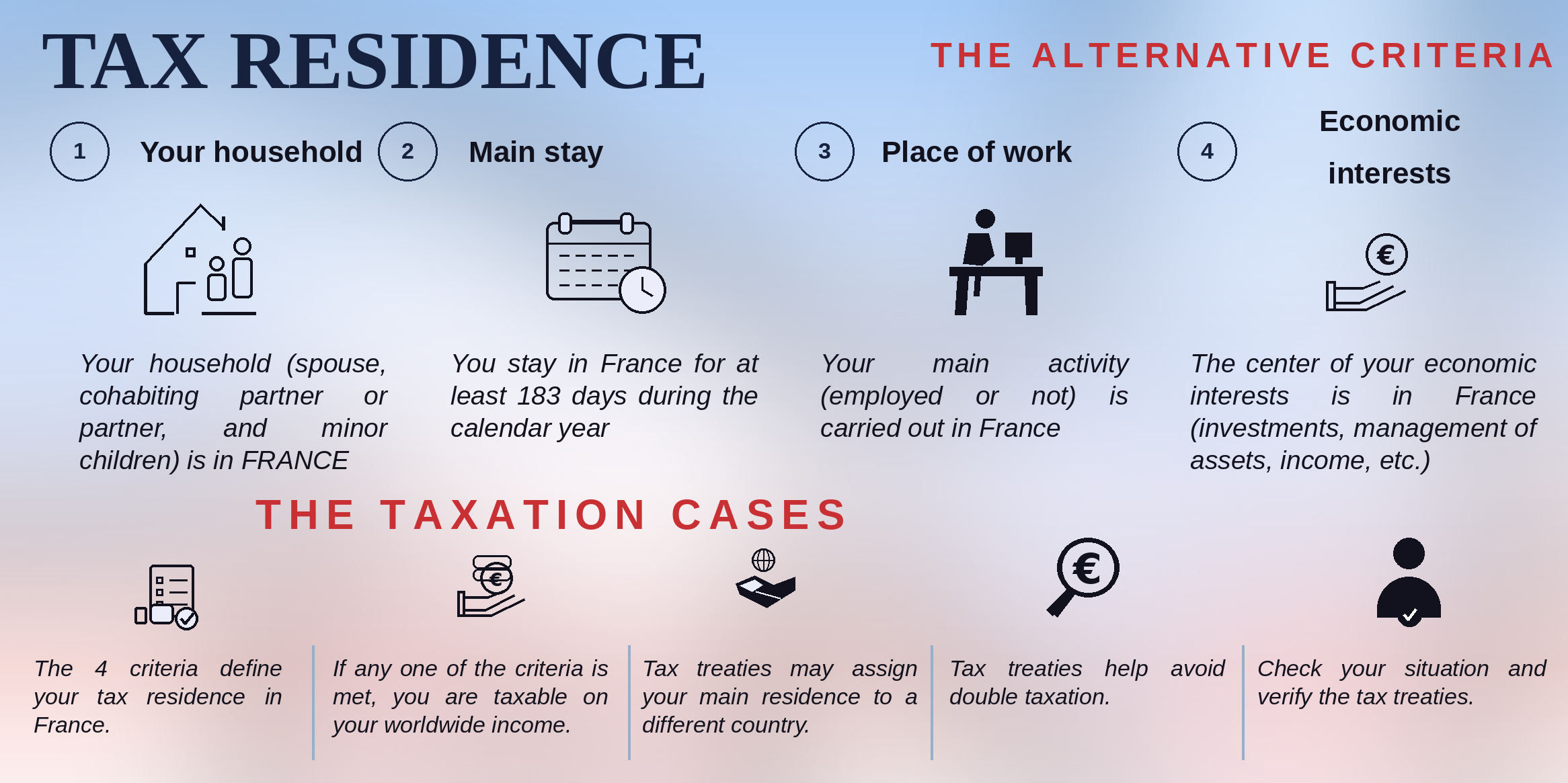
Determining your tax residence
The concept of tax residence
Article 4B of the French General Tax Code (Code général des impôts) sets out the cases in which a taxpayer’s tax residence is located in FRANCE:
1.For the purposes of Article 4 A, the following are regarded as having their tax residence in France:
a. Persons whose home (foyer) or principal place of abode is in France;
b. Persons who carry on a professional activity in France, whether as an employee or otherwise, unless they can show that this activity is carried on there only on an ancillary basis.
The executives of companies whose registered office is in France and which generate annual turnover exceeding €250 million are deemed to carry on their professional activity in France on a principal basis, unless they prove otherwise. For companies that control other companies within the meaning of Article L. 233-16 of the French Commercial Code, turnover is understood as the sum of their own turnover and that of the companies they control.
The executives referred to in the second paragraph of this point (b) are understood to mean the chairman of the board of directors where he or she also exercises general management of the company, the chief executive officer, deputy chief executive officers, the chairman and members of the executive board, managers (gérants), and other executives exercising similar functions;
c. Persons whose centre of economic interests is in France.
However, a person who meets at least one of the criteria set out in points (a) to (c) above cannot be regarded as having their tax residence in France where, under an international double tax treaty, they are not considered a resident of France.
2.State officials, employees of local authorities, and staff of the public hospital service who perform their duties or are assigned on a mission in a foreign country, and who are not subject in that country to a personal tax on the whole of their income, are likewise regarded as having their tax residence in France (…).
The exception of international double tax treaties
International double tax treaties (based on the OECD Model), numbering around 120, take precedence over the provisions of the General Tax Code. They set out the criteria for determining tax residence in one of the countries that are party to the treaty concerned.
To avoid double taxation, treaties use one of two methods: exemption or tax credit.
Under the exemption method, the country of tax residence is prevented from taxing income that has already been taxed abroad.
Under the tax credit method, the amount of tax paid abroad may be set off against the tax due on worldwide income in the country of residence, up to the limit of that tax.
Digital nomads
Determining the actual tax residence of people who work remotely or telework is difficult. A digital nomad will have a tax residence in France if their home or the centre of their economic interests is in France, even if they spend more than 183 days abroad, unless an international treaty provides otherwise.
The 18 November 2025 update to the OECD Model Convention introduces a regime for cross-border home-based work and removes the earlier commentary on teleworking. Its aim is to provide practical benchmarks for assessing when a home may constitute a “place of business” of the employer within the meaning of a permanent establishment.
However, certain States have entered reservations on this amendment and intend to propose different interpretations.
Administrative desk review
The tax authorities verify the consistency of your tax returns against the information available to them. They may request your utility statements to establish your place of residence and the number of days spent there. To protect yourself, you should keep evidence of your presence